History of the Portals
In the beginning of space travel as you know it, there was a push to go out and explore the stars. Time passed, and just as the local planets were being fully explored, a new frontier was discovered.
Portals.
Portal
A portal is an area of space containing a pattern of four glowing objects, not unlike a cluster of small stars, representing the points of a diamond.
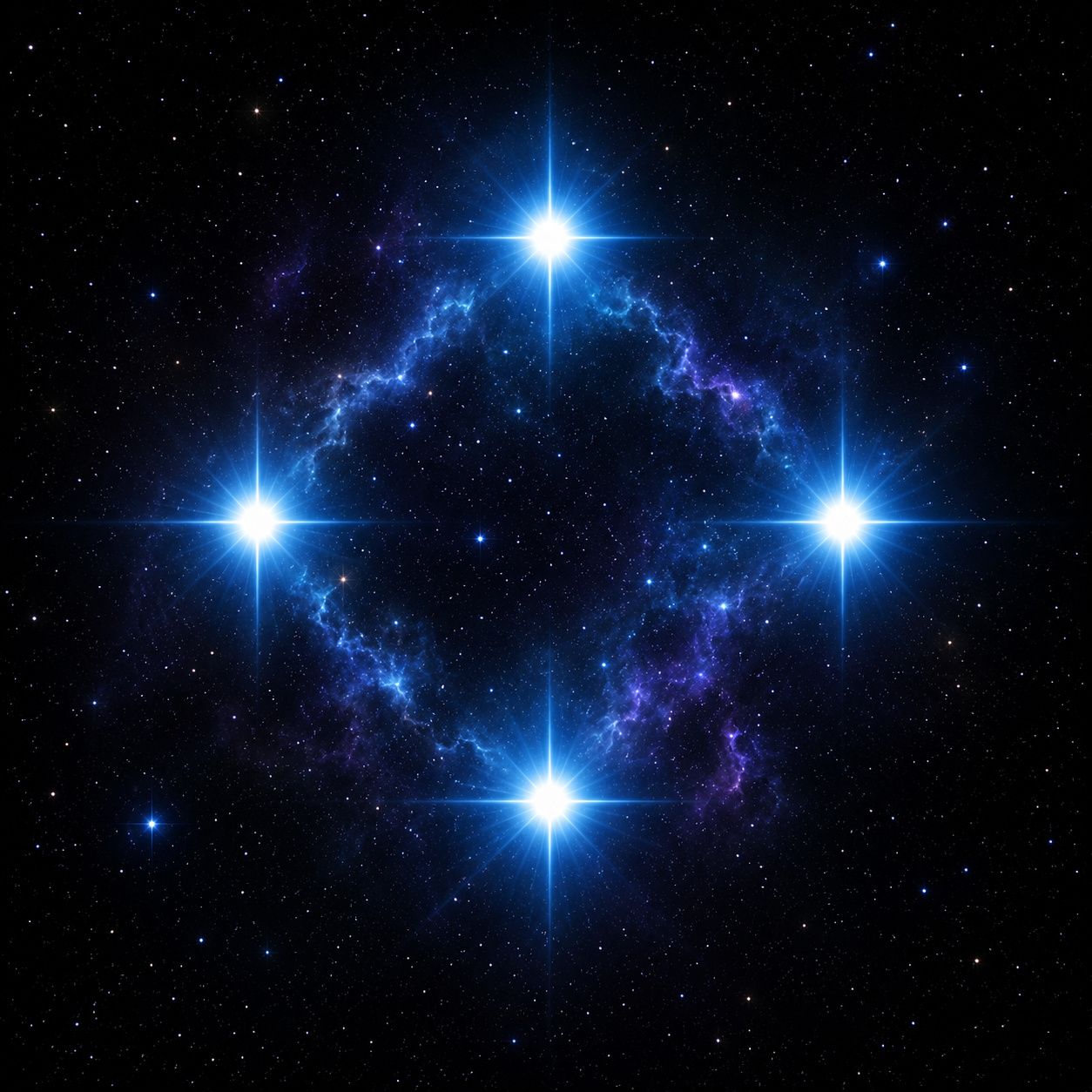
The first one was studied for years. Drones and probes were sent into the portal, but their signals were immediately lost. It appeared to the scientists that this diamond-shaped anomaly was simply a small black hole—or something similar. They never reached any firm conclusions about the portal.
Discovery!
Then one day, life in the universe would never be the same.
Earth began to receive a signal from one of the drones that had gone through the portal years before. It was transmitting from the next solar system, Alpha Centauri.
Soon afterward, signals from the other drones and probes began arriving from the same location. All the technology sent through the portal was in one piece and fully functional in Alpha Centauri!
The Only Way to Travel
A volunteer crew was assembled aboard a starship that would take them through the anomaly to Alpha Centauri. The crew knew it was more than likely a one-way trip.
Their Astrogation system was designed so that, wherever they ended up, it could take readings from nearby star patterns and calculate their position using a system of sectors and parsecs.
A Letter Home
Their first goal was to explore the Alpha Centauri system for any signs of life. When they arrived, they discovered that not only were they in the Alpha Centauri system, but there was another anomaly directly beside them.
It was where they had emerged.
The captain ordered that a drone be sent through what they now called a portal with the following message:
Good News
When Earth received the drone’s message, a world cheered! A door to another solar system had been found.
The United Nations brought the message to James’s mother and asked her to draft a reply. It went like this:
Those were the first messages ever sent between humans in different star systems. Sending messages through portals would soon become as common as shuttle flights to the Moon.
Everyone Has One
In the many years that followed, three more portal pairs were discovered, making eight portals in total and opening paths to different parts of the universe.
Each pair had the same properties as the first. As usual, scientists were divided in their explanations.
“They were built by beings of unknown origin so they could travel throughout the universe, much like the way we build highways and airports.”
“They are a natural occurrence—nothing mystical about them. They are merely holes in the fabric of space that allow objects to pass through seemingly instantaneously.”
“They were created by God so that we could expand His will throughout the stars.”
Then it happened.
The Ninth Portal was found...
The Omega-5 Is Lost
As was the normal procedure for portal exploration, an Explorer-class starship was dispatched to discover where the new portal led.
The ship did not return.
Years passed, and there was still no word from the brave explorer Commander Ned Tundell, his ship—the Omega-5—or its crew. Their story became a legend.
Assumed dead, the Ninth Portal was thereafter explored only with drones. Those drones would never be heard from again.
Eventually, the idea that the Ninth Portal led anywhere at all was abandoned.
Abandoned by everyone except a growing number of people who believed it really did lead somewhere—but that it did not offer a way back like the other portals.
These were generally the people who believed the portals had been built by aliens or that God had a hand in their creation.
Their logic was simple:
Why would they—or He—create a door that went nowhere?
Thus Began the Pilgrimage
Eventually, one company recognized an opportunity among the curious explorers and began constructing starships specifically intended to enter the Ninth Portal.
Fenton Shipyards established an operation near the portal to serve this new breed of explorer.
The ships were designed to be extremely self-sufficient. They were modular in construction and conformed to the standards used by other modular spacecraft.
At the heart of each new ship was an Omega-5 computer, named in honor of the first ship to enter the great unknown. These computers were installed inside small, heavily armored Command Modules.
Who’s in Command?
Although easily the most expensive section of the ship to construct, Fenton Shipyards claimed that a Command Module could withstand more abuse than the remainder of the ship.
If necessary, the Command Module could also function independently as an emergency escape vessel.
On T.A.P.
Also installed in the Command Module was the Take-a-Picture Astrogation System, commonly known as T.A.P.
This system was similar in design to the one used during the first portal mission.
The computer would take a picture of nearby star patterns in every direction and use complex calculations to compare them against its database. From those comparisons, it could typically determine the ship’s location almost anywhere in the known universe.
Enter Yon Brave and Foolish Captain
For reasons known only to you, you have decided to sell everything you own to purchase one of these ships.
The crew was easy to find. Thousands of people too poor to purchase ships of their own eagerly accepted the opportunity to serve aboard a “Command Ship,” as these vessels had come to be known.
They asked for no traditional pay—only room and board in exchange for a day’s work and the chance to accompany you into the unknown.
Your ship awaits at Fenton Shipyards.